



5 October 2026
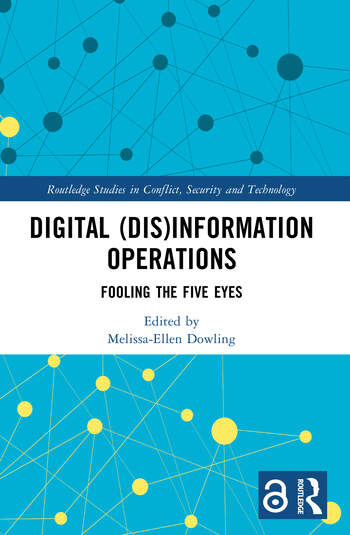
Digital (Dis)Information Operations: Fooling the Five Eyes uses an interdisciplinary approach to examine the emerging security threat of disinformation in the digital space, with particular emphasis on how this threat impacts the nations that make up the Five Eyes alliance. (The United States, the United Kingdom, Australia, New Zealand, and Canada.) Although this short text is by no means authoritative, it provides a solid basis for discussions on how states can protect their citizens in an increasingly interconnected digital world.
The book is divided into three sections. In the first section, “Human Techniques of Digital (Dis)Information Operations,” the authors focus on disinformation itself—what it is, and the ways it is (or isn’t) effective at swaying the opinions of individuals. The second section, “Human Approaches to Countering Digital (Dis)Information Operations,” explores some of the emerging individual- and community-centric approaches to limiting the threat posed by disinformation. Finally, “Transgovernmental and Intergovernmental Initiatives and Imperatives” offers some suggestions for how state actors can work to counter disinformation.
One of the book’s greatest strengths is its interdisciplinary approach. The authors who contributed to the volume come from a wide array of scholarly backgrounds, including education, psychology, linguistics, communication, law, mathematics, security and intelligence, to name a few. As a result, the book focuses on the human side of disinformation rather than the technological side, though it references relevant established and emerging technologies before setting them aside. Readers who have limited experience with digital spaces will find the book very accessible, since it is almost entirely free of jargon and does not require significant knowledge of either technological developments or the digital sphere, making the book a particularly good fit for graduate and senior undergraduate students seeking a clear understanding of human actors in the evolving digital security landscape.
Although the authors touch on the goals of state and non-state actors in using disinformation operations, they are more focused on how states (and individuals) can limit the impact of disinformation in liberal democracies. This benefits the book, since it makes its conclusions applicable to the future rather than offering only case studies of disinformation’s harm. In fact, most of the book is concerned with, as editor Melissa-Ellen Dowling writes, “emphasis[ing] opportunities to mitigate the challenge [of disinformation] through regulation, technological innovation, and international cooperation.” (p. 5) The book successfully examines the first and third category amply, with several particularly thought-provoking chapters on the role of international cooperation in minimizing harm to liberal democracies. It is somewhat less successful as regards its investigation of technological innovation, as the topic is discussed only sparingly, and it is clear that all the authors agree a human-centric approach—rather than a technological one—is the best way forward.
Overall, the book’s tone is optimistic, with a few isolated exceptions, which is refreshing. The authors tend to agree that disinformation is an undeniable threat to democracy, but not an insurmountable one. None of the authors are blind to the danger facing the public sphere (Chapter 7 particularly highlights this danger, as it examines the case of the Philippines to argue that there is no “one size fits all” approach to combating disinformation, especially when considering illiberal states and states in the Global South), but neither do they throw up their hands and assume that disinformation will become dominant in either domestic or foreign affairs. Current policymakers will find many suggestions for combating disinformation both provocative and plausible.
A weakness of the book is its scope. Although the title and many chapters reference the Five Eyes alliance, it would perhaps be more accurate to call it “Fooling the AUKUS (Australia, UK, US) Alliance.” Many chapters focus exclusively or almost exclusively on the United States and Australia; most examples of disinformation campaigns, responses to such campaigns, or legislation relating to disinformation come from these countries. The United Kingdom shows up occasionally—usually in the context of the alliance’s history, though occasionally as a modern example—while New Zealand receives serious consideration only in one chapter. Canada is functionally absent from the text; none of the authors consider it beyond noting that it is a member of the Five Eyes. It is unclear whether any of the authors have considered the Five Eyes as a collective whole, as they instead seem to understand it as a tripartite alliance that occasionally consults other English-speaking countries, assuming New Zealand and Canada will follow wherever they are led. This is especially disappointing in the current foreign-affairs context, as Canada increasingly emphasizes its sovereignty on the global stage.
All in all, Digital (Dis)Information Operations is an accessible book that introduces non-experts to ongoing discussions of digital disinformation and exposes experts in international security and policymaking to new ideas for protecting the public sphere from interference by state and non-state actors. The human-centric, interdisciplinary approach helps the book to provide an optimistic yet grounded take on digital disinformation. Although the book rests on the assumption that a few states represent the entire Anglosphere and the broader global democratic community, this limitation does not negate its positive contributions to the field. Ultimately, readers who pick up Digital (Dis)Information Operations will find that it creates a valuable foundation for discussing the changing nature of liberal democracy in the contemporary world.
Featured Photo: “Disinformation” – ChatGPT, 2026
Inset Photo: “Cover of Digital (Dis)Information Operations: Fooling the Five Eyes” – Routledge, 2026