

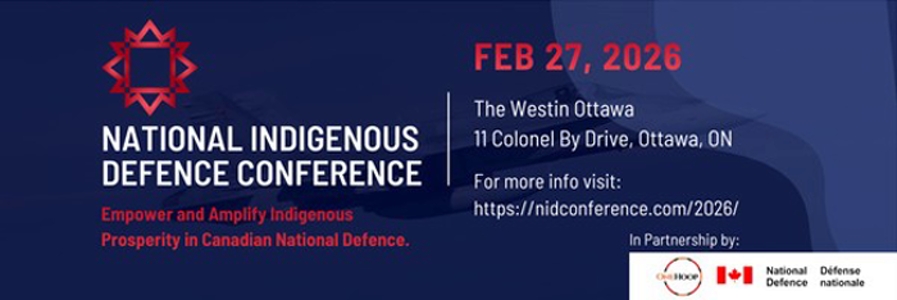
*This overview was published for the NIDC 2026, being held in Ottawa on 27 February 2026
Overview
The National Indigenous Defence Conference will advance reconciliation efforts, strengthen partnerships, build capacity, and create meaningful economic opportunities within Canada’s Defence sector. Building upon the inaugural National Indigenous Defence Conference hosted by OneHoop in partnership with the Department of National Defence in November 2024, our comprehensive framework will guide the annual conference to ensure we continue to bridge the relationship between Indigenous communities & entrepreneurs, the Canadian Armed Forces, government agencies, and defence industry partners.
This conference emerges at a critical juncture when Canada’s defence sector faces both heightened security challenges and unprecedented opportunities for Indigenous participation. The Government of Canada’s commitment to awarding at least 5% of federal contracts to Indigenous businesses, combined with significant defence investments of $82 billion over the next 5 years, creates substantial economic pathways for Indigenous communities. Simultaneously, the Canadian Armed Forces continues working toward meaningful reconciliation through Indigenous recruitment programs, the Canadian Rangers, Indigenous procurement and integration of Indigenous knowledge systems into northern operations.
Vision Statement:
Empower and amplify Indigenous prosperity in Canadian National Defence.
Mission Statement:
The National Indigenous Defence Conference fosters meaningful dialogue, collaboration, and reconciliation between Indigenous peoples and the Defence community, while advancing economic opportunities, strengthening security partnerships, and honouring Indigenous contributions to National Defence.
Conference Purpose:
The National Indigenous Defence Conference serves multiple interconnected purposes that align with Canada’s broader reconciliation commitments and defence objectives:
- Providing a national platform for Indigenous leaders, defence professionals, government representatives, and industry partners to engage in critical discussions about Indigenous perspectives on defence, military operations within Indigenous territories, environmental stewardship, and treaty rights.
- Creates tangible economic opportunities by connecting Indigenous businesses with defence procurement pathways, supply chain partnerships, mentorships and capacity-building programs.
- Demonstrating the Department of National Defence and Canadian Armed Forces’ commitment to reconciliation through concrete actions and partnerships that recognize Indigenous rights, knowledge, and contributions.
- By bringing together diverse stakeholders, the conference transforms consultation into co-creation, ensuring Indigenous voices lead conversations about defence activities affecting their communities and territories.
Key aspects of Indigenous Prosperity:
- Economic growth: Generating wealth, business success, and employment opportunities.
- Community well-being: Enhanced quality of life, health, education, and holistic wellness.
- Self-determination: The power to direct and manage economic development according to community values and visions.
- Stewardship and sustainability: Protecting and managing land, resources, and cultural heritage for current and future generations.
- Equity and inclusion: Ensuring all community members benefit and participate, not only a select few.
Strategic Themes and Focus Areas
The conference framework encompasses six interconnected strategic themes that together create a comprehensive approach to Indigenous participation in Canadian defence.
Indigenous-Military Partnerships
This foundational theme strengthens Nation-to- Nation and government-to-government relationships between Indigenous communities and the Canadian Armed Forces. Building meaningful partnerships requires recognizing treaty rights, establishing consultation protocols, and creating co-development processes for defence activities on or near Indigenous territories.
Effective partnerships must move beyond tokenistic consultation to genuine collaboration where Indigenous communities participate as equal partners in decision-making processes. This includes engagement on NORAD modernization, northern infrastructure projects, military exercises, and defence policy development. The Department of National Defence’s Indigenous Reconciliation Program supports these collaborative efforts through grants for workshops, policy research, and capacity building.
Indigenous Procurement and Economic Development
Canada’s defence sector represents a significant economic opportunity for Indigenous businesses, particularly with the federal government’s mandatory 5% Indigenous procurement target. However, Indigenous businesses face substantial barriers accessing defence contracts, including complex bidding processes, unfamiliar regulatory requirements, and limited connections with prime contractors. The conference addresses these challenges through multiple mechanisms.
The conference facilitates business-to-business connections through exhibitor showcases and sharing stories and best practices as presenters. With over 3,000 Indigenous businesses listed in the Indigenous Business Directory and defence spending of $82 billion projected over the next 5 years, even achieving the 5% target could generate $4.1 billion in opportunities for Indigenous communities. The Industrial and Technological Benefits (ITB) policy further encourages defence contractors to invest in Indigenous businesses across 17 key industrial capabilities.
The Indigenous Business Defence Sector Accelerator program, launched by the Canadian Council for Indigenous Business with General Dynamics as the inaugural sponsor, pairs Indigenous businesses with organizational sponsors who provide supply chain access, regulatory guidance, and industry knowledge. At CANSEC 2025, the Indigenous Defence Supply Chain Pilot brought 25 Indigenous businesses to Canada’s leading defence trade show, creating networking opportunities and showcasing capabilities at the Indigenous Pavilion. These initiatives demonstrate practical pathways for Indigenous businesses to participate meaningfully in defence procurement.
Reconciliation in Defence
Reconciliation serves as the overarching imperative guiding all conference activities and outcomes. The Department of National Defence and Canadian Armed Forces recognize that reconciliation is essential not only for moral and ethical reasons but also for operational effectiveness and institutional strength. Meaningful reconciliation requires concrete actions beyond acknowledgments and apologies, it demands structural changes in policies, practices, employment, and partnerships.
The conference creates accountability by bringing together senior military leadership, government ministers, and Indigenous leaders to publicly announce reconciliation commitments and track progress on previous pledges. These commitments span multiple dimensions: increasing Indigenous representation in the CAF toward the 3.5% target by 2026; implementing cultural competency training for defence personnel; integrating Indigenous perspectives into defence policy development; and ensuring military operations respect Indigenous rights and environmental stewardship.
Indigenous participation in the Armed Forces itself represents an important reconciliation pathway. Programs like Bold Eagle, the Canadian Armed Forces Indigenous Entry Program, and Indigenous Summer Training programs combine military skills training with Indigenous knowledge, creating culturally relevant pathways to service. The conference highlights these programs while examining how the CAF can better support Indigenous identity within military culture.
Indigenous Knowledge and Capabilities
Indigenous peoples possess unique knowledge systems, skills, and perspectives that strengthen Canada’s defence capabilities, particularly in northern and remote regions. Traditional knowledge of Arctic geography, weather patterns, wildlife behavior, and survival techniques proves invaluable for military operations, search and rescue missions, and environmental monitoring. The Canadian Rangers program exemplifies how integrating Indigenous knowledge enhances operational effectiveness while respecting cultural identity.
The conference explores how defence organizations can more systematically integrate Indigenous knowledge into operations, planning, and training. This includes incorporating traditional ecological knowledge into environmental assessments for military infrastructure projects; engaging Indigenous experts in Arctic security planning; and developing dual-use infrastructure that serves both defence and community needs. Critically, integration must occur on Indigenous terms, with appropriate protocols for protecting traditional knowledge and ensuring Indigenous communities maintain control over their intellectual and cultural property.
Approximately 5,000 Canadian Rangers serve in over 200 communities across Canada, with Indigenous peoples comprising an estimated 80% of Rangers in the Territorial North. Rangers provide “eyes, ears, and voice” for the CAF in isolated communities, conducting sovereignty patrols, supporting search-and-rescue operations, and sharing land-based skills with Regular Force members. Their contributions extend beyond military functions to community resilience, disaster response, and intergenerational knowledge transfer.
Northern and Arctic Security
Arctic sovereignty and northern security are critical priorities that require Indigenous participation. As climate change opens new shipping routes, increases resource accessibility, and heightens geopolitical tensions, effective Arctic defence requires deep collaboration with northern Indigenous communities who have inhabited these territories for millennia. The Yukon First Nations Defence and Security report emphasizes that when federal and territorial governments, the Canadian Armed Forces, and Indigenous First Nations work together, Canada’s northern security strengthens significantly.
Indigenous communities in the North face interconnected security challenges spanning emergency preparedness, infrastructure resilience, food security, and environmental protection. Defence infrastructure investments must address both national security priorities and community needs—airports that support military operations but also enable medical evacuations and supply delivery; telecommunications systems securing defence communications while connecting remote communities; transportation routes critical for security operations and food supply chains.
The conference facilitates dialogue on NORAD modernization, Forward Operating Locations, northern warning systems, and Arctic training exercises, ensuring Indigenous communities participate in planning from the outset rather than being consulted after decisions are made. It also addresses climate change as a security issue, examining how traditional knowledge can enhance climate adaptation strategies and disaster preparedness.
Capacity Building and Training
Systemic capacity-building ensures that Indigenous peoples and businesses can fully participate in defence-sector opportunities. The National Indigenous Defence Conference can support capacity development through multiple mechanisms. Skills development discussions and presentations covering defence procurement processes, regulatory requirements, including controlled goods certification, proposal writing, contract management, and quality assurance standards. Mentorship programs connect emerging Indigenous business leaders with experienced suppliers and industry professionals who can guide navigation of the defence sector’s complexity.
Educational pathways create long-term sustainability by inspiring Indigenous youth to pursue careers in defence-related fields. The Junior Canadian Rangers program, with nearly 3,000 participants across 157 patrols, introduces young Indigenous Canadians to military service while reinforcing cultural identity and traditional skills. Academic partnerships with institutions such as the Royal Military College, the Canadian Forces College, and the North American and Arctic Defence and Security Network support Indigenous research, policy analysis, and thought leadership.
Certification and credentialing programs help Indigenous businesses meet defence industry requirements. General Dynamics Ordnance and Tactical Systems–Canada’s commitment to supporting Indigenous companies in obtaining controlled goods certification exemplifies industry partnership in capacity building. The First Nation Procurement Authority, established May 1, 2025, will provide systematic outreach, training, and support to help verified First Nation businesses access government and corporate procurement opportunities.
For more information, contact:
Thomas Benjoe
Partner, OneHoop