


6 March 2026
I have what, to my surprise, appears to be a rather unpopular opinion in the wake of US and Israeli strikes on Iran. That is, taking out the Iranian regime is long overdue. This is a no-brainer. Iran is the largest state sponsor of terrorism in the world. It is run by a radical theocratic regime bent on destabilizing the region, all in the name of destroying the great Satan and all the rest of the Western infidels. This same regime regularly slaughters its own people en masse for daring to say they don’t want to live in the dark ages under the rule of a priest.
I have borrowed the following argument before concerning Russia, and like Russia and Putin, in Iran, we have known for decades what we are dealing with. So here it is again: Christopher Hitchens argued that there are four conditions under which a country can be said to have surrendered its sovereignty. Hitchens’ reasoning remains solid. The four criteria listed by Hitchens are repeated aggression against neighbouring states, genocide, harbouring gangsters and internationally wanted terrorists, and finally, fooling around with the non-proliferation treaty.
Is there really a need to run through how Iran has engaged in repeated aggression against neighbouring states, or worked with terrorists? The non-proliferation treaty issue shouldn’t require any explanation. Regardless of how successful or unsuccessful America’s previous strikes against Iranian nuclear facilities may or may not have been, the regime remains. This is a regime that has actively sought to produce a nuclear bomb, and the reasons are terrifyingly self-evident. We don’t want to live in a world where religious zealots have a nuke. As for genocide, maybe not in the strictest sense, but slaughtering its own people for wanting freedom is close enough.
The hard truth is that if you want a rules-based international order, like it or not, you need a guarantor because not everyone gets along, we have conflicting interests, and some are just bad actors. Even the good ones have elections, and leadership changes along with priorities and methodologies. The US has demonstrated that clearly enough.
Ask yourself this simple question: Who do you think makes the rules, and how? The Europeans and Canadians are discovering this now, the system we enjoy comes at a price, hence the sudden realization we need a military and the ‘efforts’ to rebuild (or at least appear to in the case of Canada) new militaries …why?, so they can participate in shaping and maintaining the system.
President Trump is likely not the best choice to deal with this, and his methodology can rightly be criticized as deeply flawed, but that doesn’t make him wrong. The world was better off with Saddam dead, and it’s better off with Khamenei dead, along with any other Ayatollah. I honestly don’t care what Trump’s motivations are, and I doubt the Iranian people care either.
With the mention of Saddam, many of you will jump at the chance to point to ISIS after Saddam as proof that the world is not better with Saddam dead. You are not the student of history you think you are, and you are conflating two separate issues. That was a failure to handle the US’s win. Killing Saddam was not what created ISIS it was the true believers in the Bush administration ignoring the lessons from how victory over Germany in the Second World War was handled. Instead of using the infrastructure in place, the US dismantled it, disbanded the military, outlawed the Ba’athists and manufactured a power vacuum.
The solution may be straightforward: stay the course, waste IRGC military assets, kill Ayatollah after Ayatollah, bomb the IRGC until they accept their time is at an end. Then demand they hand things over to the pro-democracy movement, allowing for an interim government and elections. There will be no rally around the flag effect. This is not Britain in the Second World War. The Iranian people want the regime gone. The above might also prove incredibly simplistic, the Iranian regime has been singularly focused on this very scenario. This will, no doubt, cause significant short-term disruption to the global economy. The alternative is to ask what happens in the long-term if this regime gets to remains, continuing to fund terrorist groups and then actually succeeds in developing a nuclear weapon?
Sometimes there are no good options, just a choice between several bad options, where you try and figure out which of them is the least bad.
The people wringing their hands about bombing Iran and what comes next are falling into the trap of focusing on the wrong things. They are eschewing a net good for fear of something that may come next if we screw it all up, while simultaneously ignoring what happens if we do nothing. Getting rid of the IRGC is a move towards safety and stability, not insecurity. It’s the follow-up that can go wrong or right, making for greater stability or creating a new threat. Admittedly we’ll probably screw it up, given the current US administrations track record that’s a real concern. Western leaders may not like hearing this, but if you want to help chart the course of that follow-up, you need to have skin in the game. That means supporting the US with significant enough involvement to have influence. You can’t do it standing on the sidelines.
The Iranian regime has been preparing for this and it won’t be simple and easy, but it is possible. Furthermore the difficulties faced in the immediate are paltry compared to what will certainly come if the problem is ignored. This is not Iraq or Libya, and I am (uncharacteristically) optimistic because of the Iranian people. What can I say, when I see kids in the street with punk rock t-shirts telling priests to fuck off because they want freedom, a vote, and a say in their country’s future, even at the risk of death, I feel reassured.
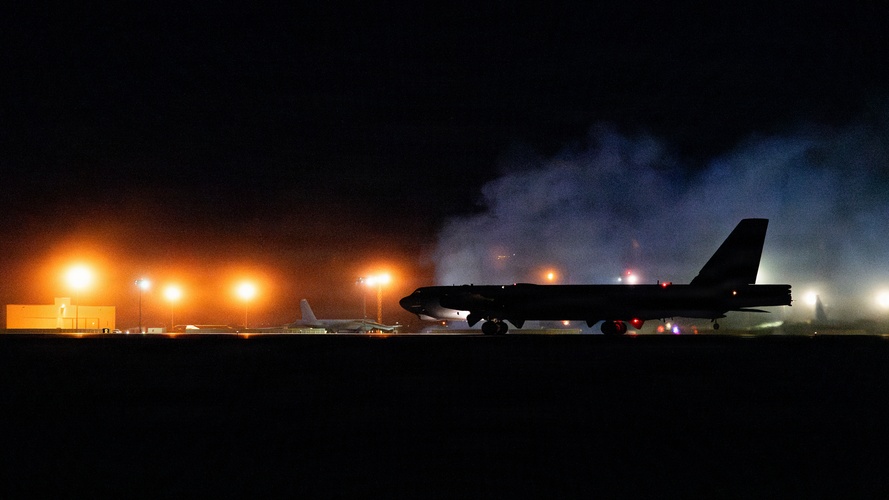
Feature Photo: U.S. Air Force Photo, B-52H Stratofortress Bombers Support Operation Epic Fury (Mar 5, 2026), U.S. Central Command Public Affairs. 2026.
DefenceReport’s Analysis and Opinion is a multi-format blog that is based on opinions, insights and dedicated research from DefRep editorial staff and writers. The analysis expressed here is the author’s own and is not necessarily reflective of any institutions or organizations which the author may be associated with.