


The United States has amassed the largest air force in the Middle East since the first Gulf War. The air power in that campaign was built on a coalition of allies. At the moment, the USS Abraham Lincoln is on station, and the USS Gerald Ford is on its way from operations in the Caribbean and recently sailed through the Strait of Gibraltar.
There are indications that the United States is moving F-16 and F-22 fighter jets, as well as air refuelling assets. The aircraft carriers carry F-35s and various other fighter jets, including specialized electronic-jamming aircraft such as the EA-18 Growler. The US has deployed additional Patriot and THAAD air defence systems to the Middle East in anticipation of an Iranian response.
The Iranian regime believed that it could quell the nationwide protests through bullets and violence. With the amount of air assets in the Middle East, the US objective would be to cripple the Iranian government, the IRGC and the Iranian military as much as it could. But there is no indication that an Iranian resistance would be able to rise up and take over governmental control.
Iran’s air defence forces proved to be unable to deter or inflict damage on US and Israeli action during the 12 Day War in June. There are no indications that Iran has replaced the lost equipment or improved its air defence capabilities since.
The Axis of Resistance, then Iran established through providing support to Hamas, Hezbollah, and the Houthis, has essentially been degraded to the point that it does not provide any level of deterrence to Israel. Iran provided weapons, missiles, and some intelligence support to the Axis.
Regionally, only the Afghan Taliban have issued their support for Iran if the situation deteriorates into war. Iran is an isolated pyriah state. Russia has also proven to be an unreliable partner, so there will be no Russian assistance.
So, the question of whether Iran has any other cards left presents itself. The deck seems to be stacked in favour of the United States. There are reports that the US is preparing for an operation that could last weeks.
The Dark Card
There is one option for Iran: al-Qaeda. The UN Analytical Support and Sanctions Monitoring Team concluded in 2023, based on intelligence gathered from UN member states, that al-Qaeda’s leader, Sayf al-Adel, has been residing in Tehran. Iran denied the findings that it was sheltering al-Adel. But the accusation that Iran has hosted al-Qaeda members goes back to the 1990s and has been written on by many analysts and previous directors of the CIA.
Al-Adel was born between 1960 and 1962 and was a lieutenant colonel within the Egyptian military before he joined the mujahideen call to fight the Soviets in Afghanistan. Later, he joined al-Qaeda. Thomas Joscelyn wrote that al-Adel was trained by Hezbollah and had ties with the Iranian regime during his posting. According to the 9/11 Commission Report, in the 1990s, “senior al Qaeda operatives and trainers travelled to Iran to receive training in explosives,” while others “received advice and training from Hezbollah” in Lebanon.
Al-Adel has been wanted by the US government for his involvement in the 1998 embassy bombings in Kenya and Tanzania. After the US embassy bombings, he was under loose house arrest during the early 2000s by the Iranian regime.
Iran has had a history of providing shelter for al-Qaeda leadership and operatives for decades. Although it is not openly discussed within al-Qaeda or Iran. It would then be known that the Sunni jihadists of al-Qaeda would be seeking shelter from the Shia regime of the Islamic Republic of Iran.
Al-Qaeda franchises in Iraq and Afghanistan attacked the Shia community relentlessly. But it is the hatred of the United States, as the Great Satan, that they find commonality. Enough commonality for the Iranian regime to shelter al-Qaeda members. Even within the Axis of Resistance, Hamas is Sunni. Iran’s support of Hamas was predicated on Hamas’ shared hatred of Israel, which provided Iran another proxy terrorist ally in the region.
Iran has permitted al-Qaeda members within its territory, but it has never provided intelligence or logistical support in financing or weapons. It did help facilitate the training on al-Qaeda members, but no uniformed Iranian officer provided that training – it was done through proxy groups, such as Hezbollah. Facilitation and not direct operational support.
The Afghan Taliban, who also deny that al-Qaeda is operating from within Afghanistan, has offered the Iranian regime an opportunity. The spokesman for the Taliban, Zabihullah Mujahid, pledged that the Taliban would offer cooperation and solidarity. However, there has been no public explanation as to what that would entail. Iran and the Taliban have a pragmatic, often tense, partnership. And the tension is rooted in the Shia-Sunni division. The question would be what support the Taliban would be able to offer. It does not have air defences, and the Iranian regime is not facing a ground invasion by the United States.
How it would work
The only viable thing that the Taliban could offer is a territorial safe haven for assets that Iran wants to keep safe from a week-long air campaign. This could mean essential government personnel, such as Ali Khamenei and high-ranking generals. During the 12-day war, Iran’s military leadership was effectively targeted by Israel with airstrikes. During such a transfer of personnel and assets, it is reasonable to assume that members of the IRGC are also transferred to Afghanistan. It would have to be an overtly clandestine operation.
For Iran to do so, however, would be a policy and theological hurdle. One that would embrace al-Qaeda rather than allowing its presence. However, it would be doing so in Afghanistan, with that territorial buffer zone and deniability.
Those IRGC could include trainers and intelligence officers who could provide further training of al-Qaeda fighters, but also intelligence support for al-Qaeda’s globalized franchised organization. Al-Qaeda could, then, attack American interests in Africa and in the Middle East with better information and organization. Al-Qaeda Central, in Afghanistan, maintains ideological control, offers guidance, and leverages its Taliban-backed safe haven for its members. Therefore, the viability to orchestrate attacks is possible.
It would not be the decisive blow against the United States, but enough to cause concern for the Trump administration. Attacks on American-run mines, embassies, military bases and even the outlier attack on the US homeland would cause a policy shift for the Trump administration and probably the realization that his peace plan in Afghanistan did not work.
Iran cannot embolden its Axis of Resistance in the short-term; its air defence network was degraded by Israel before the attacks on Iran’s nuclear facilities, and it cannot offer a maritime response against one US aircraft carrier group (soon to be two). Turning to the devil that it has had dealings with since the 1990s is justifiable if it means the continuation of the Islamic regime. That’s why Iran’s emboldening of al-Qaeda is a possibility. Iran may make use of al-Qaeda and attempt to garner a deal that would make the globalized terrorist organization the Axis of Resistance 2.0.
Again, it would mean that Iran would have to have a massive sea change in policy and risk the world knowing that it outwardly offered operational and tactical assistance to al-Qaeda. Given the state of geopolitics and the threat of regime collapse, it cannot be ruled out entirely.
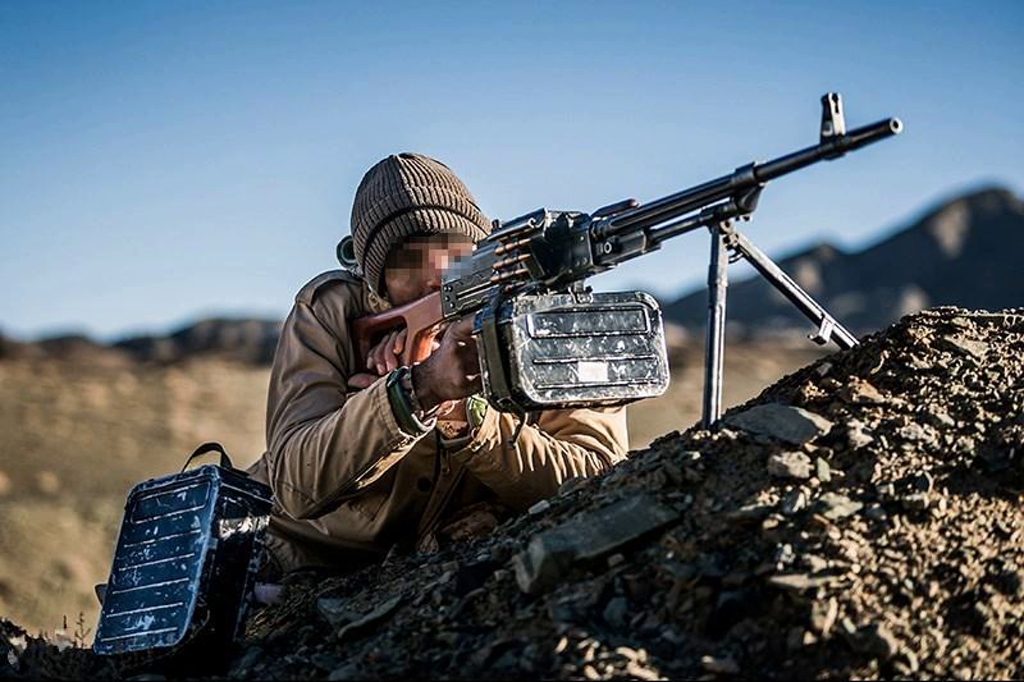
Featured Photo: “IRGC Commando, c. 2017”, Wikimedia Commons, 2026