
22 May 2026
Sponsored Article
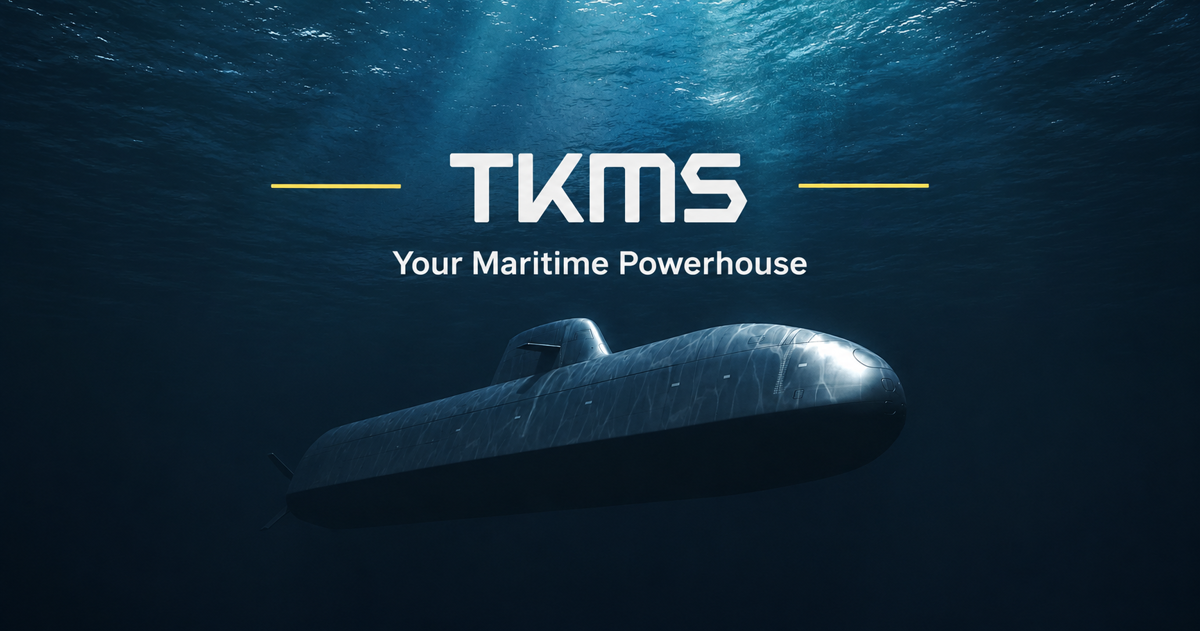
The closing for the Canadian Patrol Submarine Project (CPSP) is coming to an end. The two main competitors – TKMS and Hanwha Ocean have revised their bids. The two competitors revised their bids. A decision from the Canadian government is expected in the coming months. TKMS is uniquely situated to provide and sustain Canada’s next submarine fleet. TKMS has done so with variants of the Type 212 globally.
The following parameters weigh the CSPS bid:
- 50%: Sustainment and support capability after purchase.
- 15%: The company’s financial wherewithal and stability.
- 15%: The economic benefits and industrial partnerships offered to Canada in relation to the contract.
- 20%: The physical platform itself (its capabilities and design).
50%: Sustainment and support capability after purchase
In-service support is the big contract for any Canadian supplier. The in-service support contract with TKMS or Hanwha Ocean is where the long-term investment occurs, and the amount is larger than the acquisition of the submarines. The operational life of the CPSP should be between 35 and 45 years. Obviously, the issues and interoperability of the Victoria-class submarines demonstrated that in-service support costs are important to factor in. These are complex ships with complex systems, and their maintenance is key to the ship’s survivability, but more importantly, to its crew.
TKMS has a long history of creating partnerships to sustain the submarine exports to:
- Type 212A: Germany and Italy
- Type 214: Greece, South Korea, Portugal, Turkey
- Type 212CD: Germany and Norway
- Dakar-class: Israel
TKMS has proven itself capable of providing NATO allies with submarine capabilities. It should be noted that the in-service support contracts include Canadian businesses. Still, with the TKMS contract, many of those contracts offer opportunities to help sustain and be part of the logistical chain for the German and Norwegian 212CD fleets. At the moment, there are no foreign sales of the Hanwha KSS-III. The partnership among Norway, Germany and Canada will enable those fleets to adjust their designs, upgrades and maintenance through knowledge sharing.
15%: The company’s financial wherewithal and stability.
TKMS has a backlog of over USD 22 billion in international defence contracts. TKMS launched an Initial Public Offering on the Frankfurt Stock Exchange in October, and since then, its stock has soared. In doing so, TKMS splintered from its parent company, Thyssenkrupp AG. Thyssenkrupp AG still retains a 51% majority, but the remaining 49% is owned by shareholders. Thyssenkrupp was created in 1999 with the merger of Thyssen and Krupp. Thyseen was originally established in 1867, and Krupp in 1811.
15%: The economic benefits and industrial partnerships offered to Canada in relation to the contract.
TKMS has sought partnerships across Canada, including industry and academia. Partnerships that go beyond the depths of the seas, but also to space. TKMS recently partnered with Isar Aerospace to build Canada’s space-based capabilities. TKMS also partnered with a Canadian security-first enterprise AI company, Cohere, to “support decision-support workflows, onboard information management, training environments, and secure naval interfaces.”
TKMS’ bid demonstrates its intent to build a sustainable support network for the 212CD in Canada. It indicates that it will integrate Canadian supply chains into the sustainment of the German and Norwegian 212CD fleets. The TKMS bid is more about industrial integration, where design and engineering knowledge will be transferred to Canada’s shipbuilding industry and will also enable greater partnerships with German and Norwegian industry. This strategy is more in line with Canada’s Industrial and Technological Benefit (ITB) policy, which was established around the launch of the National Shipbuilding Strategy under Prime Minister Harper. The aim is to transfer technological knowledge to Canada’s defence industries, so Canada can continue to innovate and be globally competitive.
20%: The physical platform itself (its capabilities and design).
The Canadian government stated that there are no differences between the TKMS and Hanwha designs. And that is incorrect.
The Hanwha KSS-II has ten vertical launch missile tubes. This means Canada will have to purchase South Korean missiles and have in-service support contracts to maintain that inventory. Tomahawk cruise missiles have been known to be launched horizontally from other submarines, namely the British. If Canada wants that capability, the Royal Canadian Navy (RCN) has options. The RCN would also need a policy justification for such an armament. The Canadian government has issued no Defence White Paper or Foreign Affairs paper for some time.
The Type 212CD has a non-magnetic hull, which provides strong countermeasures against magnetic sea mines and airborne Magnetic Anomaly Detectors (MADs). This will also translate to more autonomous underwater vehicles (UUVs). It also has a diamond-shaped hull to reduce its sonar signature.
The Russian-Ukrainian War has demonstrated how warfare is changing with the adoption of drones and surface-water drones. The blockade of the Strait of Hormuz is once again demonstrating the utility of sea mines. Warfare is still entering this phase of influx, where drones and irregular warfare measures are proving their worth, while big systems like tanks and surface vessels are coming into question with drones and potential drone swarms soon.
The Canadian government can choose a submarine manufacturer that has supported NATO members in the past, present, and future. The TKMS deal will bring Canada closer to Europe, as Canada has signed on to the ReArm Europe initiative and could attract additional European contracts. This will be done by investing both financial resources and, more importantly, knowledge in Canada’s defence industries.
This is a sponsored article from TKMS. TKMS reserves copyrights for the images.