

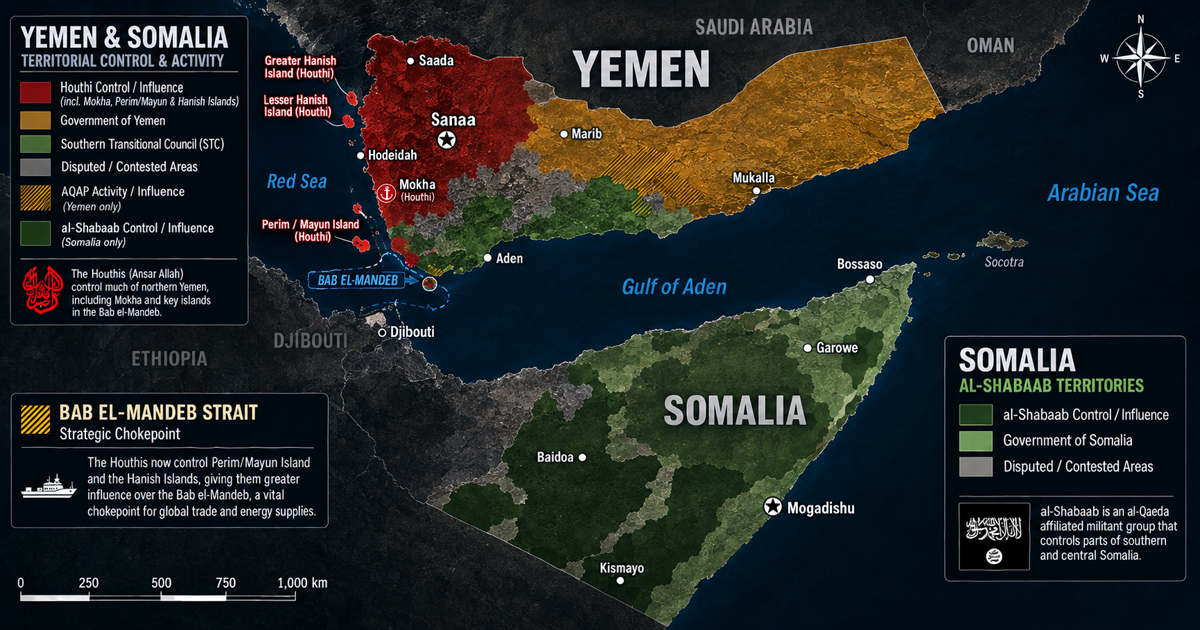
The Houthi rebels have essentially created a stranglehold on a third of the world’s shipping with their recent victories over Yemeni forces and the seizure of islands within the Bab el-Mandeb Strait. However, there is a wider strategy involving al-Shabaab in Somalia and al-Qaeda in the Arabian Peninsula (AQAP), which operate in Somalia and Yemen.
The United States and the Houthi rebels have essentially agreed to maintain the 2025 ceasefire. President Trump told Mohammed bin Salman that the US will provide intelligence and targeting support but will not take an active combat role. Over the weekend of 11-14 September, US officials and Houthi representatives met in Oman. According to reports, the Houthis said they had no intention of targeting US and Israeli vessels and would adhere to the 2025 negotiated ceasefire. In essence, the Houthis will have time to fortify their positions within the Bab el-Mandeb Strait. It is a narrow strait, and ships can be targeted with conventional artillery systems.
The Houthi rebels are part of the wider Iranian Axis of Resistance. The Houthis are attempting to expand the territory they hold during the wider Iran war. The Houthis have been Iran’s backup card. They have been involved in the wider Iran war but have only fired a few missiles toward Israel until now. Attacking Saudi Arabian cities, the Holy site of Mecca, and oil facilities sow unrest in the region and the wider oil and fuel market – causing prices to rise.
There has been an alarming development where the Houthis in Yemen have become closer to al-Shabaab in Somalia. This would mean the two groups would have a presence on both sides of the entrance to the Red Sea. Al-Shabaab on the southern coastline of the Gulf of Aden and the Houthi rebels controlling the eastern coastline of the Red Sea and the Bab el-Mandab Strait. Recently, the Houthi rebels captured not only the city of Mokha but also several islands within the strait.
Houthis and al-Shabaab
There is an existing relationship between al-Shabaab and the Houthi rebels. The Houthis have enlisted Africans into their ranks. This also includes those from neighbouring Somalia. The Houthis have approached al-Shabaab, and the links have continued to grow. There have been arms transfers from the Houthis to al-Shabaab through smuggling.[1] Yemeni-based groups have been supplying various groups in Somalia since 1991. Iranian ships have also smuggled weapons for both the Houthis and al-Shabaab. The point is that the Houthis are already a regional power that has influence in Somalia and with al-Qaeda’s affiliate, al-Shabaab.
The concern is, of course, that al-Shabaab and the Houthis coordinate a closure of the Red Sea. Al-Shabaab have requested missiles from the Houthi rebels. In addition to this, al-Shabaab have benefited from Houthi drone technology, which was given to the Houthis by Iran. According to the Monitoring Team, al-Shabaab is seeking to “improve the range and accuracy of its mortar systems and to acquire drone‑jamming technology to evade surveillance and air strikes.”[3] Increased capabilities could translate into gains for al-Shabaab in Somalia.
According to the UN Sanctions and Analytical Monitoring Team, al-Shabaab has been concentrating its operations along Somalia’s eastern coastal districts. [4] The Monitoring Team also noted that al-Shabaab’s revenue has decreased from $12-15 million a month to $ 5-9 million due to increased security measures, as well as “drought in Jubbaland, Shabelle Hoose and Shabelle Dhexe and reduced collections in Mogadishu.”[5] Al-Shabaab needs another revenue stream to bolster its finances. There is an option for them, and that is funding through the Houthis, Iran, and al-Qaeda in the Arabian Peninsula (AQAP).
Al-Qaeda in the Arabian Peninsula
According to the UN Monitoring Team, “[d] uring the reporting period, several al-Shabaab fighters entered Yemen through coastal routes and moved to Shabwah and Ma’rib, where they met with AQAP to exchange expertise and coordinate logistics.”[6] AQAP wants to develop a drone that can carry up to 1 kilogram of explosives and is expanding its maritime capabilities.[7] AQAP has territorial influence on Yemen’s south coast in Abyan.
The Houthis have met with AQAP and have a logistical and technological relationship with al-Shaabab. AQAP does not have a combat presence in Somalia, but exerts its presence primarily through logistical, financial, and strategic partnerships across the Gulf of Aden. AQAP has hired out its fighters to the Houthis and has hoped to coordinate smuggling activities with the Houthis.
According to the UN Sanctions and Analytical Monitoring Team, AQAP took advantage of a vacuum in southern Yemen and strengthened its presence and capabilities. What is also alarming is how AQAP is maintaining relations with both the Houthis and al-Shabaab.[8] AQAP could act as an intermediary and provide al-Shabaab with enhanced operational capabilities.
Going Forward
Yemen’s Interior Minister Major General Ibrahim Haidan recently warned that “[t]he danger is not limited to the threats that exist today, but extends to what is being built for the future.” The crisis looming in the Bab el-Mandeb Strait is not distant. The Houthi rebels are part of Iran’s Axis of Resistance and are the only group of that which has not been degraded and is not flourishing. Controlling the Bab el-Mandeb Strait means that the route to the Suez Canal can be cut off and cargo has to transit around Africa – increasing time, costs and delays to the global supply chain.
Iran can continue to strengthen the Houthis, al-Shabaab and AQAP with technology and munitions. It may actually be Iran’s revamped Axis of Resistance. I discussed at the outset of the war how Iran might move closer to the Taliban and al-Qaeda Central in Afghanistan given how the regime might need a safe haven for elites, and how al-Qaeda’s leader resides in “house arrest” in Tehran.
There is pressure for the Houthis to escalate. The Afghan Taliban have even weighed in and have asked the Houthis to escalate to draw Pakistan into the conflict through the Mekka (Mecca) Agreement. There will be a time when Iran needs to pressure the Houthis to close the Bab el-Mandeb to increase political and economic pressure on the United States.
But what is also being built in the future is a closer alliance of the Houthi rebels, al-Shabaab and AQAP. A regional understanding in which they will assist each other’s ambitions and might even serve Iran’s bid for continued support.
[1] Century International, “From Spoke to hub: The Axis Ecosystem in the Gulf of Aden and the Red Sea”, 24 August 2026, available at: https://production-tcf.imgix.net/app/uploads/2026/08/24153623/24-08-26_Houthis_in_Africa.pdf, p. 10
[2] Century International, “From Spoke to Hub”, pp. 13-14.
[3] Analytical Support and Sanctions Monitoring Team, “Thirty-eighth report”, pp. 10-11.
[4] Analytical Support and Sanctions Monitoring Team, “Thirty-eighth report”, p. 10
[5] Analytical Support and Sanctions Monitoring Team, “Thirty-eighth report”, p. 10
[6] Analytical Support and Sanctions Monitoring Team, “Thirty-eighth report”, p. 15
[7] Analytical Support and Sanctions Monitoring Team, “Thirty-eighth report”, p. 15
[8] Analytical Support and Sanctions Monitoring Team, “Thirty-eighth report of the Analytical Support and
Sanctions Monitoring Team submitted pursuant to resolution 2734 (2024) concerning ISIL (Da’esh), Al-Qaida
and associated individuals and entities” https://docs.un.org/en/S/2026/651 10 August 2026, p 10.