


8 July 2026
The Russian-Ukrainian War sparked a drone revolution and has altered how wars are conducted. The direction was already set, but that conflict sped up the evolution and standardization of drones. Drones have become an integral part of the modern battlefield.
It should be remembered that smaller, civilian drones were being adapted by non-state actors before Ukraine, including ISIS in Iraq and Syria. Drones are becoming increasingly prevalent in war zones across the globe. The UN High Commissioner for Human Rights (UNHCHR) Volker Türk stated in a speech that over 1,000 civilians have died in Sudan between January and May 2026 due to drone strikes.
Technology is becoming increasingly evident in the 21st-century battlespace.
Drones, GPS spoofing, and electronic warfare countermeasures are becoming more prevalent in the 21st-century battlespace. Drone proliferation is occurring with various insurgent and terrorist groups around the world. As technology improves and becomes cheaper, accessibility becomes more widespread, and the entry-level knowledge decreases — the essence of a threat multiplier. It is not just about drones, but also the evolution of software-defined radios, adaptive waveforms, and frequency agility.
A Canadian company, Zighra, is building systems to counter the new realities of drone warfare, electronic warfare, and contested sensing environments. While AI has become common language in defence procurement, Zighra is not simply another company adding ‘AI’ to defence tools. Its work is centred on a sensor-agnostic foundation model – an AI layer that can learn across radio frequencies (RF), radar, Global Navigation Satellite Systems (GNSS), and other sensing modalities to understand normal behaviour, detect anomalies, infer intent, and provide operators with actionable situational awareness.
A recent article in the Journal of the NATO Science and Technology Organization outlined the threats posed by GNSS spoofing and jamming. There are plans to enhance security around GNSS, including GPS and Galileo. However, there needs to be another level of protection. Systems can be hacked, or countermeasures can advance, making GNSS vulnerable again. That’s just the reality that the modern battlefield is facing — it is not just about the effectiveness of drones, but new countermeasures against our GPS and other sensors. Spoofing can make our equipment think we are in a different position, that threats are not imminent, or that they are coming from a different direction. As we become more reliant on technology, there will be the technological equivalent of camouflage or the magnet next to the compass on a ship diverting it from course.
As threats rapidly change frequencies, signatures, and behaviours, the advantage will go to forces that can understand what their sensors are seeing – and recognize when those sensors are being deceived, degraded, or manipulated. That is where Zighra’s approach sets it apart.”
I had the pleasure of speaking with Deepak Dutt, the CEO of Zighra. Dutt has an extensive background in communications and spent his formative years with Nortel before entering the cybersecurity industry.
One can tell that Zighra is building new detection systems grounded in battlefield reality. It is not just about detecting drones, but also about being watchful of how electronic countermeasures can affect your own equipment. This is a digital battlefield reality that will only grow more dangerous.
PointSpectrum
There is growing availability and use of software-defined radios (SDRs), which allow potential threats to change their waveforms and communication patterns. The war in Ukraine demonstrates the need for SDRs on the battlefield, as Ukraine routinely targets radio transmissions from commercial-grade radios and cell phone calls – transmissions that are on a single waveform.
The advantage of using an SDR is that it converts raw radio-frequency signals to digital data and enables transmission across multiple frequencies with a single device. Multiple frequencies make it harder to jam. The detection of a device emitting multiple frequencies, and what those frequencies are, is the difference between neutralizing a threat.
Again, one of the lessons from the Ukraine-Russian War that our adversaries will also learn and adapt from. Thus, we need the ability to detect and countermeasure.
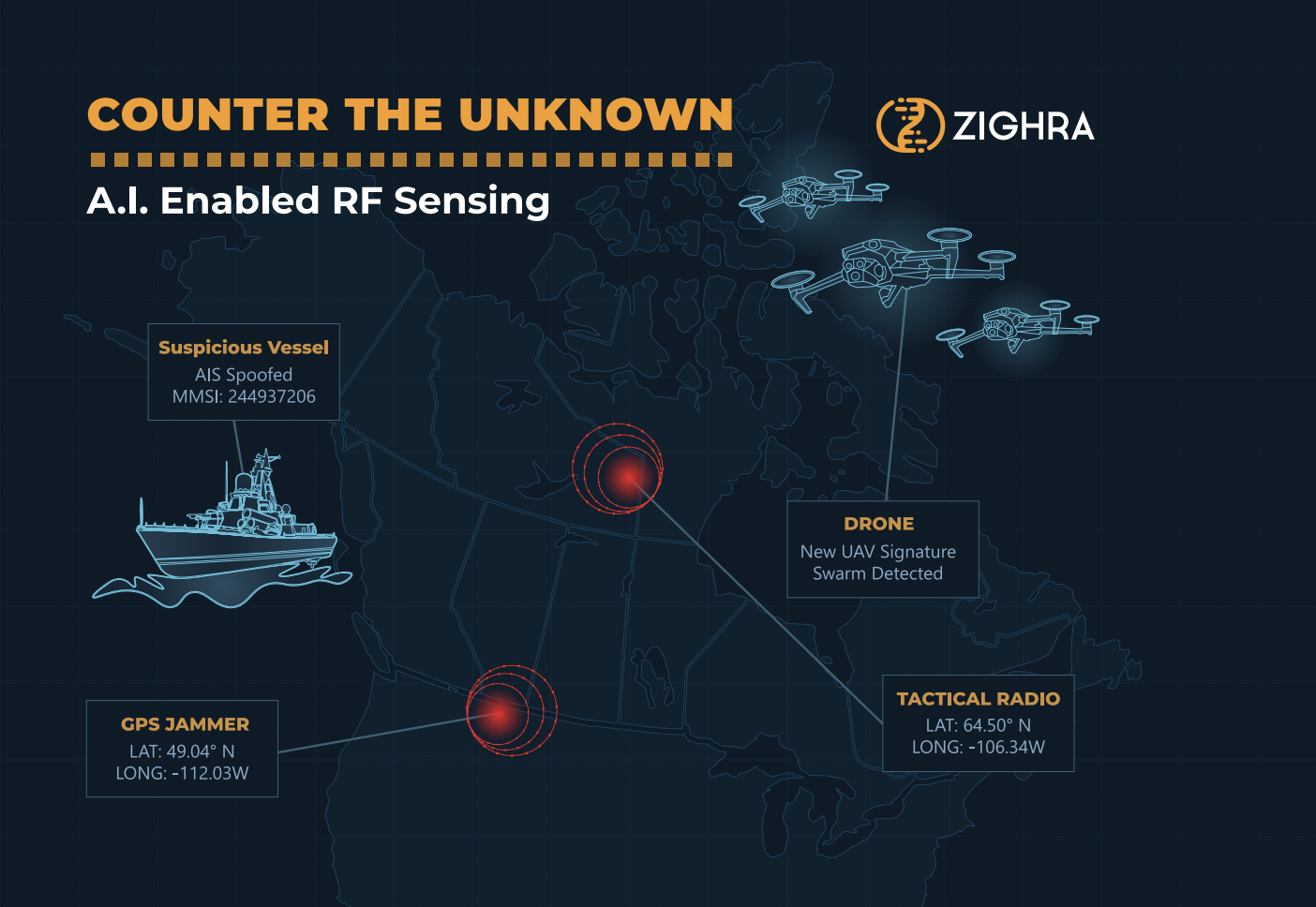
Zighra’s PointSpectrum is designed to detect, characterize, and localize RF emitters, including signals associated with software-defined radios. It will detect various active emitters and scan the electromagnetic field to create visual threat awareness, using AI-enabled RF sensing and an intelligence system.
PointSpectrum will also provide awareness if the opponent’s electromagnetic warfare is disrupting sensors. This includes disruptions to the Global Navigation Satellite System (GNSS). Sensor jamming and interference could lead to warships, tanks, platoons (for example) to be led off course and into ambushes or even just deemed combat ineffective as they are not where they should be.
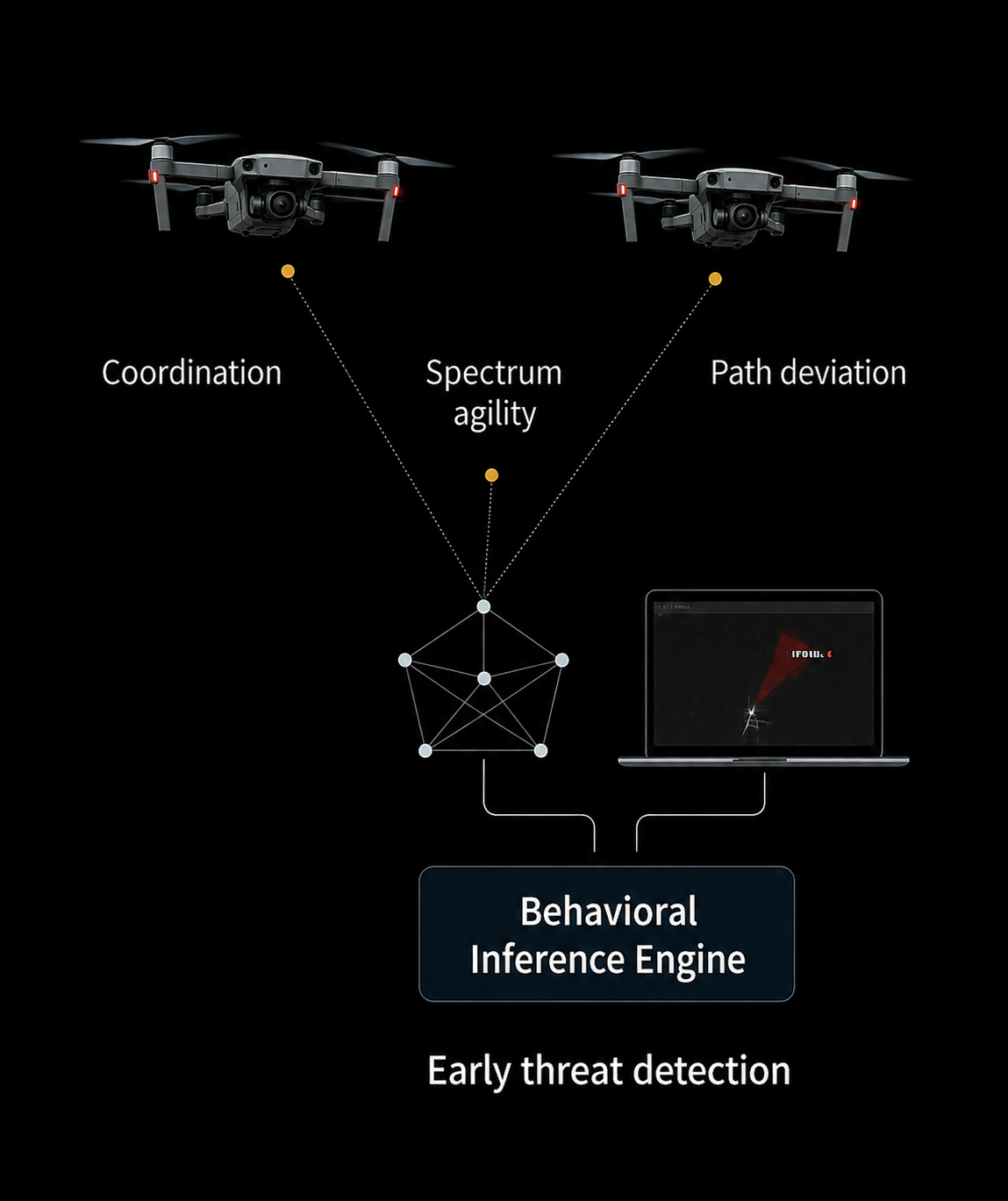
Zighra utilizes AI, and its system can understand the electromagnetic battlespace in as little as a few minutes, then provide awareness of potential threats. Zighra states that they can do this even in “highly-congested and contested environments”. It is about establishing a radio-frequency baseline and then detecting anomalous activity. The AI system can also support the creation of new entries for emerging frequencies and behaviours through its RF libraries and behavioural inference engine. Thus, creating an evolving library that it can more effectively utilize to detect threats. The speed of detection, action, and neutralization of drones, electromagnetic countermeasure interference, is and will continue to be the key to our troops’ survival and combat effectiveness on the field.
PointSpectrum is a modular system that can integrate with commercial-off-the-shelf (COTS) systems. Zighra’s software-based modular systems enable it to integrate with existing equipment more efficiently.
IntentHunter
The Canadian Department of National Defence recently awarded Zighra a contract to support the “testing of IntentHunter, an AI-powered intent inference and situational awareness software platform designed to help counter rapidly evolving drone threats, referred to as uncrewed aerial systems (UAS).”
IntentHunter examines RF, radar, and Electro-Optical/Infrared (EO/IR) signals and, with its AI analysis, helps assess whether a UAS appears benign, suspicious, or hostile. This will enable ground troops to be prepared and counter enemy UAS threats, ensuring the safety of bases and critical infrastructure.
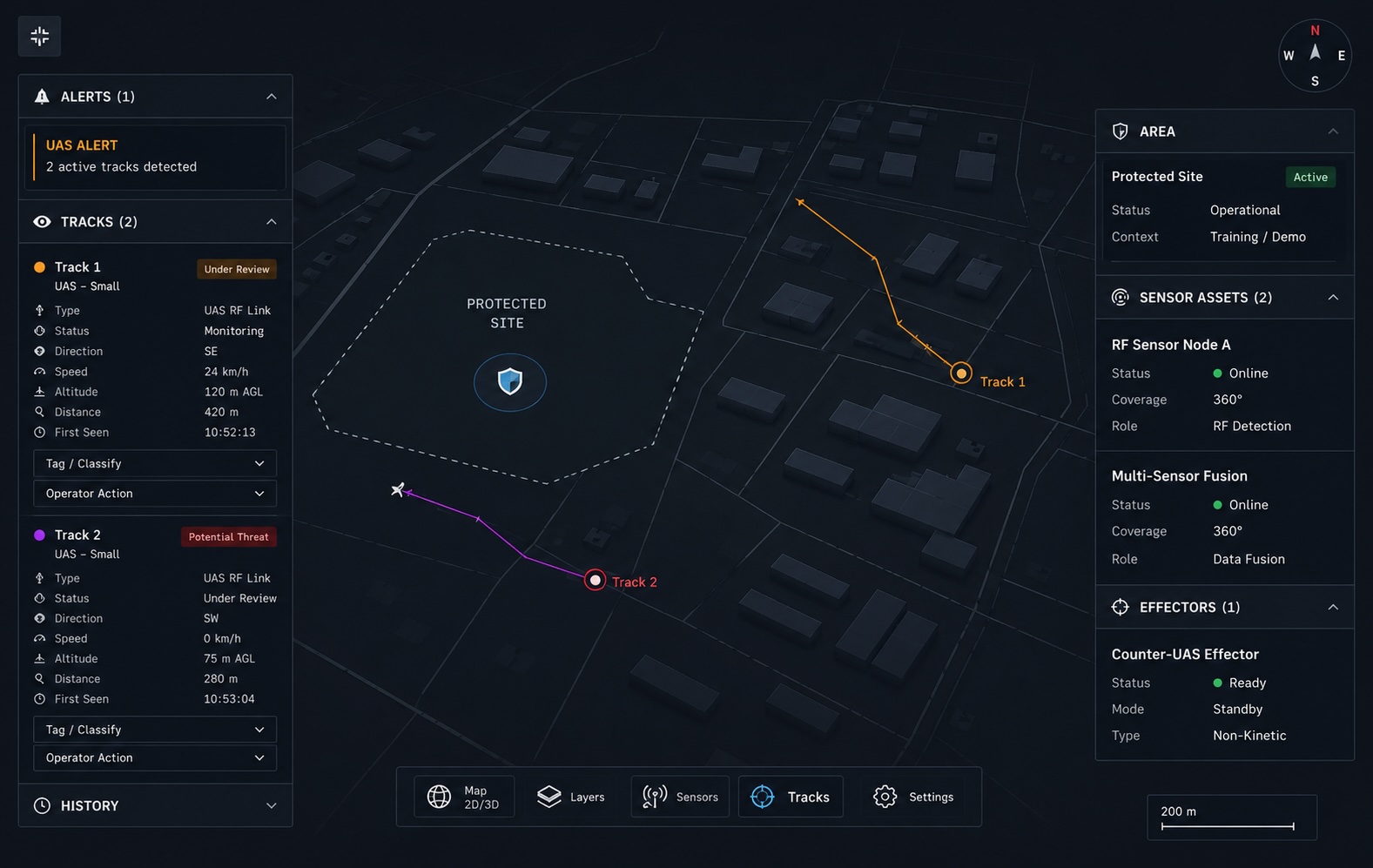
Detection is digitally mapped out, and the user can then direct action more fluidly. This shows operators where potential enemy UAS are located, enabling faster decision-making and potentially saving lives and equipment.
Advantage
One of Zighra’s key advantages is its adaptability. Because Zighra’s systems are software-driven, they can be integrated with legacy systems without major upgrades. Imagine enabling it on older warships, tanks, base command-and-control systems, and even infantry squads — modern detection at minimal cost, while integrating with existing platforms.
That adaptability also translates into a more economical way to adapt legacy systems, such as older tanks and warships.
Their AI system continues to learn and build a large database of threats, potential threats, and allied systems and frequencies.
Zighra’s products can help the Canadian Armed Forces and other NATO allies meet the challenges of the 21st-century battlespace. Zighra is proving to be at the forefront of detection and decision-support capabilities that soldiers, sailors and aircrews will need in the near future — if not immediately.
Feature Image: Zighra Company Logo with ChatGPT Assistance
Inset photos: Provided by Zighra