


26 May 2026
*Article submitted ahead of CANSEC 2026 by LaFlesche
Thirty-six years after Canadian troops deployed on Mohawk territory, a precision manufacturer from Kahnawàːke is supplying components to General Dynamics, CAE, and others — and building a case that Indigenous excellence and national security are the same conversation.
In the summer of 1990, the Canadian Armed Forces deployed soldiers and armoured vehicles to the south shore of Montreal. The 78-day Oka Crisis — triggered by a dispute over a golf course expansion onto Mohawk ancestral burial grounds near Kanesatake — saw warriors from the neighbouring community of Kahnawàːke erect blockades on the Mercier Bridge in solidarity. The standoff became one of the defining confrontations between Indigenous peoples and the Canadian state in the modern era.
Three and a half decades later, a manufacturer rooted in that same Mohawk community is supplying components to some of Canada’s largest defence contractors. That is not an accident. For LaFlesche Inc., it is the whole point.
A Company Built on Kahnawàːke Soil
LaFlesche is headquartered at 1 Rock Road West on Kahnawàːke Mohawk Territory, roughly 20 kilometres southwest of Montreal. It is an 80 percent Indigenous-owned advanced manufacturer offering precision CNC machining, custom injection molding, mold making, engineering and design, prototyping, and assembly services — with a client roster spanning defence, aerospace, and medical sectors.
The company is one of the few Canadian manufacturers operating directly on-territory. That distinction carries real economic weight: the wages, the skills development, the supply chain relationships — they stay in the community. Economic sovereignty, not just economic participation.
Even the company’s name was chosen with great intention, having been inspired by one of Indigenous North America’s most remarkable figures: Dr. Susan Picotte La Flesche. In 1889, Dr. La Flesche became the first Indigenous person to earn a medical degree in the United States, graduating as class valedictorian. She did so 31 years before women could vote in that country, and 35 years before Indigenous people were given US citizenship. Rather than leave her community, she built a hospital that served anyone — regardless of colour — across a 1,350-mile service area. LaFlesche, the company, carries that same ethic: build something exceptional and bring your entire community with you.
Manufacturing That Meets Defence-Grade Standards
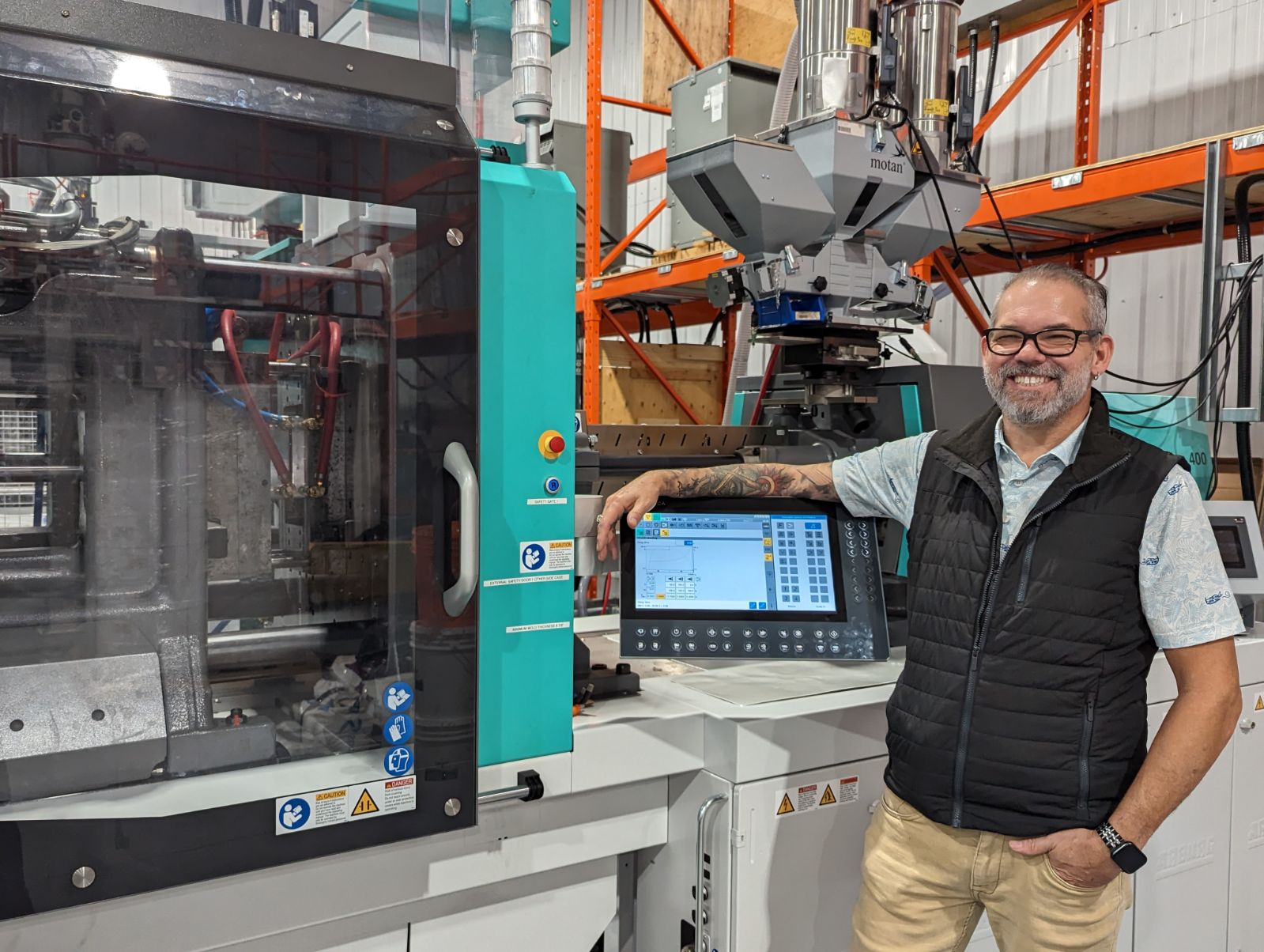
Defence supply chains are unforgiving environments. Tight tolerances, full lot traceability, detailed inspection reports, and the engineering bandwidth to collaborate directly with programme teams are baseline expectations. LaFlesche has demonstrated it meets them.
The company’s CNC machining division handles milling, turning, EDM and wire EDM, and laser cutting across stainless steel, titanium, and specialty tool steels, with surface treatment capabilities including zinc, passivation, conversion coating, and anodizing. Its injection molding operation — which includes mold design, tooling, and high-run production — operates to clean room standards with an in-house quality inspection lab and full lot tracking.
That breadth of capability — from first-article prototype through to production-scale delivery — is uncommon in the Canadian Indigenous business ecosystem. And the validation from tier-one clients is now on the record.
“The LaFlesche team exceeded our expectations in both the management of the information we provided and their technical capabilities. Their interactions with our engineers were productive and efficient, with the goal of delivering molded plastic products on an exceptional timeline and at outstanding quality. They designed the mold sets, proposed design improvements, and delivered a high-quality product with a detailed inspection report. LaFlesche stands out as a solution provider for injection-molded plastic products.”
— Martin Richard, Director, Supply Chain and Integrated Planning — General Dynamics Ordnance and Tactical Systems–Canada Inc.
CAE, the Montreal-based flight simulation and training company, has offered an equally pointed endorsement from its global procurement team:
“The LaFlesche team was exceptional. Not only did you understand our vision — you also brought innovative ideas to the table. Our procurement team couldn’t be happier with the results. We appreciate your professionalism, communication, and willingness to go above and beyond. We highly recommend LaFlesche to any business looking for a skilled and reliable partner.”
— Ayman Eid, Global Procurement & Supply Management — CAE
GD OTS and CAE are not companies that casually absorb supply chain risk. Their willingness to commend LaFlesche publicly — by name, in writing — is the kind of signal that programme managers and procurement officers read carefully.
The Procurement Environment Has Shifted
LaFlesche’s rise is unfolding against a backdrop of significant policy change in Canadian defence procurement.
In March 2026, Canada formally achieved NATO’s two-percent-of-GDP defence spending target — the largest year-over-year increase in a generation. Prime Minister Mark Carney has committed to a path toward five percent of GDP by 2035, a trajectory that translates into hundreds of billions in platform acquisition, sustainment, and industrial base investment over the next decade.
At the same time, the federal Procurement Strategy for Indigenous Business (PSIB) now mandates a minimum five percent of federal contracts be directed to certified Indigenous firms. For prime contractors managing Industrial and Technological Benefits (ITB) obligations, Indigenous suppliers with genuine manufacturing depth — not just commercial services, but defence-grade fabrication — are increasingly rare, and increasingly valuable.
LaFlesche is certified through the Canadian Council for Aboriginal Business (CCAB) and is a member of CADSI, AIAC, and STIQ. The company participated in CANSEC 2024 with support from the Department of National Defence’s Indigenous Reconciliation Program, has been selected for the Indigenous Business Defence Sector Accelerator, and holds a position within the Defence Industry Advisory Group. AS9100 certification is complete — a milestone that unlocks direct eligibility for the most demanding aerospace and defence programme scopes.
Building Futures, Not Just Parts
What distinguishes LaFlesche from a capable precision machine shop is what it is simultaneously building within Kahnawàːke. Since its founding, the company has taken on more than a dozen interns and apprentices from the community, creating structured pathways into advanced manufacturing, business administration, technical trades, and defence supply chain employment.
In a community where the memory of uniformed troops and razor wire is still generational, that is consequential.
The company’s president, Thawennontie Thomas, is direct about the stakes:
“Our community has always had something to prove. We’re not asking for a seat at the table out of obligation — we’re earning it through capability. LaFlesche exists to demonstrate that Indigenous excellence and national security aren’t separate conversations. They’re the same one.”
— Thanwennontie Thomas, President — LaFlesche Inc.
The long-term ambition is scaled accordingly. LaFlesche is targeting acquisitions of industry-adjacent businesses to vertically integrate their supply chains, offer end-to-end services to their clients, and be a key player in Canada’s $63B in annual defence spending.
What CANSEC Delegates Should Know
For prime contractors, programme managers, and procurement officials walking the floor at the EY Centre this week in Ottawa, LaFlesche presents a straightforward proposition: a verified Indigenous supplier with active tier-one client relationships, defence-grade fabrication capabilities, and a community commitment that makes every contract more than a transaction.
The arc from the Oka Crisis to this moment is not lost on anyone in Kahnawàːke. But at CANSEC 2026, that arc is no longer only a story of reconciliation. It is a supply chain entry in a General Dynamics procurement system. It is a standing recommendation from CAE’s global sourcing team. It is a manufacturer asking to be evaluated on one criterion above all others: capability.
Canada’s defence industrial base needs more of what LaFlesche is building. And Kahnawàːke is building it deliberately.
Images provided by LaFlesche